
Monday, December 1, 2014
Three Prokaryotes
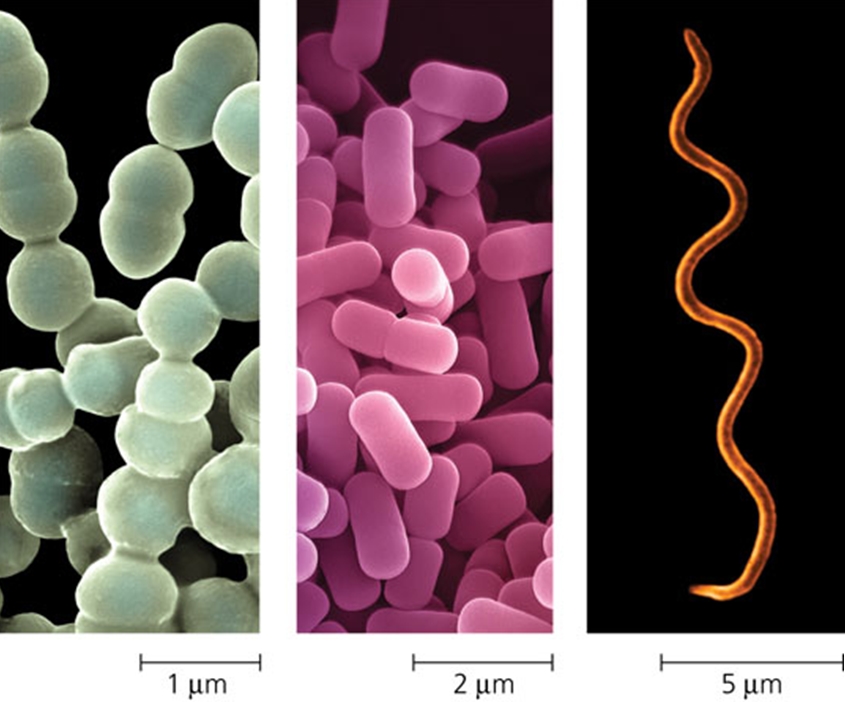
Some of the diversity of prokaryotes is evident in their external features, including shape, cell walls, and projections such as flagella. These features are useful for identifying prokaryotes as well as helping the organisms survive in their environments, Determining cell shape by microscopic examination is an important step in identifying prokaryotes. Spherical prokaryotic cells are called cocci. Rod-shaped prokaryotes are called bacilli. A third prokaryotic cell shape is spiral, like a corkscrew. Spiral prokaryotes that are relatively short and rigid are called spirilla; those with longer, more flexible cells that cause Lyme disease, are called spirochetes. Nearly all prokaryotes have a cell wall, a feature that enables them to live in a wide range of environments. The cell wall provides physical protection and prevents the cell from bursting in a hypotonic environment. Some prokaryotes have external structures that extend beyond the cell wall. Many bacteria and archaea are equipped with flagella, adaptions that enable them to move about in response to chemical or physical signals in their environment. Biology book page 320-321

Protistan Diversity
Protists are bewilderingly different. Oxygen-using prokaryotes established residence within other, larger cells. These endosymbionts evolved into mitochondria, giving rise to heterotrophic eukaryotes. Autotrophic eukaryotes also arose through endosymbiosis of a prokaryote by a eukaryote after a heterotrophic eukaryote engulfed an autotrophic cynobacterium. If the cynobacterium continued to function within its host cell, its photosynthesis would have provided a steady source of food for the heterotrophic host and thus given it a significant selective advantage. And because the cynobacterium had its own DNA, it could reproduce to make multiple copies of itself within the host cell. In addition, cynobacterium could be passed on when the host reproduced. Over time, the descendants of the origin cynobacterium evolved into chloroplasts. The chloroplast-bearing lineage of eukaryotes later diversified into the autotrophs green algae and red algae. On subsequent occasions during eukaryotic evolution green algae and red algae themselves became endosymbionts following ingestion by different heterotrophic eukaryotes. The heterotrophic host cells enclosed the algal cells in food vacuoles but the algae survived and became cellular organelles. The presence of the endosymbionts, which also had the ability to replicate themselves, gave their hosts a selective advantage. -Biology book page 331


Monday, November 17, 2014
Sea Star Life Cycle
Animals are multicellular, heterotrophic eukaryotes that obtain nutrients by ingestion. Ingestion means eating food. Most animals are diploid and reproduce sexually. Male and female adult animals make haploid gametes by meiosis, and an egg and a sperm fuse, producing a zygote. The zygotes divides by mitosis, forming an early embryonic stage called a blastula, which is usually a hollow ball of cells. In the sea star and most other animals, one side of the blastula folds inward, forming a stage called a gastrula. The internal sac formed by gastrulation becomes the digestive tract, lined by a cell layer called the endoderm. The embryo also has an ectoderm, an outer cell layer that gives rise to the outer covering of the animal and, in some phyla, to the central nervous system. Most animals have a third embryonic layer, known as the mesoderm, which forms the muscles and most internal organs. After the gastrula stage, many animals develop directly into adults. Others, such as the sea star, develop into one or more larval stages first. A larva is an immature individual that looks different from the adult mammal. The larva undergoes a major change of body form, called metamorphosis, in becoming an adult capable of reproducing sexually. Biology book pg 366


Sym Gene Testing
The hypothesized importance of sym genes to plants also predicts that their function should have changed little over time. That is, the sym genes of liverworts should work similarly to those of flowering plants. Scientists tested this prediction by using Agrobacterium to introduce a functional liverwort sym gene into an angiosperm possessing a nonfunctional version of the gene that could not form mycorrhizae. The investigators then applied fungal spores to the roots of transgenic plants and a control group of mutant plants. After several weeks, mycorrhizae were present in the transgenic plants--the result of the liverwort sym gene functioning normally. The control plants had no mycorrhizae. -Biology book pg 360

http://oregonstate.edu/dept/nursery-weeds/weedspeciespage/liverwort/female_sporocarp_750.JPG
http://oregonstate.edu/dept/nursery-weeds/weedspeciespage/liverwort/female_sporocarp_750.JPG

Fungi Life Cycle
Fungal reproduction typically involves the release of vast numbers of haploid spores, which are transported easily over great distances by wind or water. When the hyphae meet, their cytoplasms fuse. But this fusion of cytoplasm is often not followed immediately by the fusion of "parental" nuclei. Thus, many fungi have what is called a heterokaryotic stage, in which cells contain two genetically distinct haploid nuclei. Hours, days, or even centuries may pass before the parental nuclei fuse, forming the usually short-lived diploid phase. Zygotes undergo meiosis producing haploid spores. In asexual reproduction, spore-producing structures arise from haploid mycelia have undergo neither a heterokaryotic stage nor meiosis. Many fungi that reproduce sexually can also produce spores asexually. In addition, asexual reproduction is the only known means of spore production in some fungi, informally known as imperfect fungi. Mold and yeast is also imperfect fungi. The term mold refers to any rapidly growing fungi that reproduces asexually by producing spores, often at the tips of specialized hyphae. The term yeast refers to any single-celled fungus. -Biology book pg 356


Angiosperm Life Cycle
In angiosperms, the sporophyte generation is dominant and produces the gametophyte generation within its body. Meiosis in the anthers of the flower produces haploid spores that undergo mitosis and form the male gametophytes or pollen grains. Meiosis in the ovule produces a haploid spore that undergoes mitosis and forms the few cells of the female gametophyte, one of which becomes an egg. Pollination occurs when a pollen grain, carried by the wind or an animal, lands on the stigma. As in gymnosperms, a tube grows from the pollen grain to the ovule, and a sperm fertilizes the egg, forming a zygote. A seed develops from each ovule. While the seeds develop, the ovary's wall thickens, forming the fruit that encloses the seeds. When conditions are favorable, a seed germinates, which means it began to grow. Biology book pg 351


Plant Life Cycles
Plants have cycles that are very different from ours. Humans are diploid individuals--that is, each of us have two sets of chromosomes, one from each parent. Gametes are the only haploid stage in the human life cycle. Plants have an alternation of generations: the diploid and haploid stages are distinct, multicellular bodies. The haploid generation of a plant produces gametes and is called the gametophyte. The diploid generation produces spores and is called the sporophyte. In a plant's life cycle, these two generations alternate in producing each other. In mosses, as in all nonvascular plants, the gametophytes is the larger, more obvious stage of the life cycle. Ferns, like most plants, have a life cycle dominated by the sporophyte, Today about 95% of all plants, including all seeds plants, have a dominant sporophyte in their life cycle. The life cycles of all plants follow a pattern. -Biology book pg. 346
 http://apps.cmsfq.edu.ec/biologyexploringlife/text/chapter19/19images/19-06.gif

Subscribe to:
Posts (Atom)